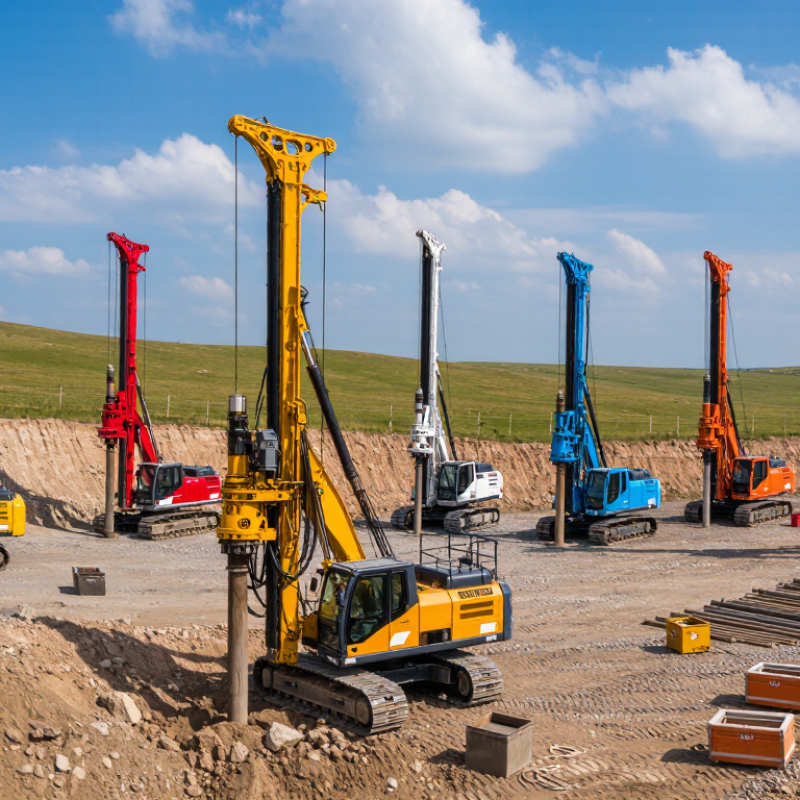
Choosing an Anchor Drill Rig is rarely just a matter of comparing prices. Ground conditions, drilling depth, anchor type, and site access can change which machine makes sense. A compact rig may fit a steep hillside or a narrow work area, while a larger hydraulic model may suit demanding, repeated drilling. Small details matter. Mast reach, feed force, rotation torque, and the time needed to reposition the rig can affect daily production. So can the availability of spare parts and trained service support.
This guide explores seven anchor drill rigs offered in markets around the world. It considers practical factors such as mobility, power source, operating controls, maintenance access, and the kinds of projects each model may serve. Manufacturer specifications are useful, but they do not tell the whole story. A quoted drilling capacity, for example, may depend on tooling, rock conditions, and the operator’s setup. That is easy to overlook. The comparisons here are a starting point, not a substitute for a site assessment or a conversation with a qualified supplier. No single rig is best everywhere, and some product details may change between configurations. Buyers should verify current specifications, parts support, and operating requirements before making a decision. There is no perfect shortlist. There can still be a better-informed one.
An anchor drill rig is best understood through the work it performs, not its model name. EN 1537:2013 covers the execution of ground anchors used to transfer tensile forces into soil or rock. A typical anchor has a free length, which stretches under load, and a fixed length, where grout bonds the tendon to the ground. The rig must drill and install this system while supporting the specified hole direction, diameter, and ground conditions. Details matter.
On site, the choice of rig affects casing needs, flushing, access, and grout placement. A compact rig may reach a restricted slope, yet struggle with deep casing in unstable ground. There is no universal “best” setup. The FHWA technical report Ground Anchors and Anchored Systems (FHWA-IF-99-015) describes proof testing commonly at 1.33 times the design load, with test load limited to 80% of the tendon’s specified minimum tensile strength. These figures connect equipment selection to verifiable anchor performance, rather than drilling speed alone. Test requirements vary with the project specification and applicable standard. One practical weakness remains: crews can focus on rig capacity and overlook access for stressing and testing. A neat bore is not proof of a reliable anchor.
A useful anchor rig comparison starts with the job, not the headline number. The figures below are screening profiles, not verified specifications for particular machines. Check rated torque, pullback, stroke, and engine power under the same measurement conditions.
A compact rig may offer 12 kN·m torque, 90 kN pullback, 2.5 m stroke, and 75 kW power. A light-duty unit could reach 18 kN·m, 140 kN, 3.0 m, and 110 kW. A mid-range model might provide 25 kN·m, 200 kN, 3.5 m, and 150 kW. For longer anchors, consider a configuration near 32 kN·m, 260 kN, 4.0 m, and 185 kW.
Larger options could include 40 kN·m, 320 kN, 4.5 m, and 220 kW; 50 kN·m, 400 kN, 5.0 m, and 280 kW; or 65 kN·m, 500 kN, 6.0 m, and 350 kW. More power is not automatically better. Check ground conditions, rod diameter, and the required anchor length before comparing prices. Confirm whether pullback is continuous or peak-rated, and ask how stroke changes with the mast setup. Small specification differences matter. Also check service access, transport dimensions, and duty-cycle limits; these details are easy to overlook in a neat comparison chart.
Choosing among anchor drill rigs for sale worldwide starts with ground conditions, not brochure torque. Rotary systems suit stable soil and weathered rock, where steady cutting helps keep holes straight. They can be efficient, but loose gravel may collapse before an anchor is installed. That matters.
Rotary-percussive rigs combine rotation with impact, helping penetrate dense gravel, hard layers, and fractured rock. Vibration can improve progress, yet it may disturb nearby structures or produce uneven holes in mixed formations. Compare hammer energy, feed force, and tooling against actual bore logs, not just maximum depth. Small differences count.
Casing systems support the hole as drilling advances through fill, loose sand, or water-bearing ground. This reduces collapse risk and keeps the bore usable for grouting, though casing adds handling time and weight. Check compatible casing diameters, rod lengths, compressor capacity, and transport dimensions before buying. Ask about service coverage and spare-part lead times in the intended region. I would still expect trial drilling; soil changes quickly, and specifications cannot capture every layer.
| Rig Type | Primary Drilling Method | Ground Conditions That Often Suit It | Typical Anchor Applications | Key Advantages | Main Limitations | Selection Considerations |
|---|---|---|---|---|---|---|
| 1. Crawler-Mounted Rotary Anchor Rig | Rotary drilling with a hydraulic rotary head; flushing may use air, water, or drilling fluid depending on the tooling and ground. | Soil, weathered rock, and some fractured formations where rotation and suitable flushing can maintain the bore. | Ground anchors, tiebacks, soil nails, and micropiles on slopes, retaining walls, and construction sites. | Tracked mobility and a stable working platform; adaptable to different drill bits, rods, and flushing arrangements. | Uncased holes may collapse in loose, saturated, or running ground. Large or difficult sites may require substantial access and setup space. | Check mast reach and inclination, available flushing systems, rod handling, access width, and whether temporary casing is needed. |
| 2. Top-Hammer Rotary-Percussive Rig | Rotation combined with impact delivered through a top hammer and drill string. | Competent rock and many fractured rock formations; performance depends on rock strength, jointing, tooling, and borehole design. | Rock anchors, slope stabilization, and anchor holes where penetration in rock is a priority. | Impact energy can help advance holes in hard rock; the method can be effective where a purely rotary bit progresses slowly. | Drill-string energy losses can become more significant as hole depth increases. Vibration and noise may affect nearby structures and sensitive sites. | Assess rock quality, required hole diameter and depth, proximity to structures, and the project’s vibration and noise limits. |
| 3. Down-the-Hole (DTH) Hammer Rig | A pneumatic hammer works near the bit at the bottom of the hole, with rotation and compressed air used to advance and clean the bore. | Hard, competent rock and some fractured rock, where compressed-air drilling and cuttings removal are suitable. | Rock anchors and other drilled ground-support holes in rock, including applications requiring relatively straight holes. | Hammer impact is applied close to the bit, which can be advantageous in deeper rock holes compared with top-hammer drilling. | Requires a suitable high-pressure air supply. Air and cuttings control can be challenging in water-sensitive, urban, or environmentally restricted areas. | Confirm compressor capacity, water conditions, cuttings management, allowable noise, and whether air drilling is permitted. |
| 4. Concentric Casing-Advance Rig | A casing system advances alongside the drill bit, supporting the bore as drilling progresses; tooling arrangements vary by system. | Loose overburden, mixed ground, and formations prone to collapse, especially where continuous temporary support is valuable. | Anchors and tiebacks through unstable overburden, fill, or mixed soil-and-rock profiles. | Supports the hole during advancement and can reduce the risk of collapse or loss of the bore in unstable ground. | Casing and specialized tooling add cost and handling requirements. Casing may be difficult to recover in some formations or layouts. | Check casing diameter and depth, extraction requirements, obstructions, groundwater, and compatibility with the anchor installation sequence. |
| 5. Eccentric Casing-Advance Rig | An offset or eccentric overburden system drills while advancing casing; the casing can commonly be withdrawn after the hole is completed. | Unconsolidated overburden, gravel, and heterogeneous ground where an unsupported bore may not remain open. | Anchors through unstable soil layers, including sites where the bore needs temporary casing during drilling. | Can advance casing through difficult overburden while drilling, helping maintain borehole stability. | Ground behavior, boulders, and obstructions can affect progress and casing recovery. Tooling selection is formation-dependent. | Review the expected ground profile, casing recovery plan, required bore diameter, and clearance around the rig. |
| 6. Compact Mast or Mini Anchor Rig | Usually rotary or rotary-percussive drilling in a compact, modular, or low-clearance configuration. | Sites with restricted headroom, narrow access, or limited working space; ground suitability depends on the fitted drilling system. | Retrofit anchors, basement and tunnel work, slope repairs, and drilling near existing structures. | Small footprint and flexible positioning can make access possible where a larger rig cannot operate. | May have lower available power, shorter mast reach, or more limited rod handling than larger rigs. Productivity can be affected by frequent repositioning. | Measure access and headroom, verify mast angle and reach, and confirm the rig can handle the required tooling and anchor depth. |
| 7. Truck-Mounted Multi-Purpose Anchor Rig | Rotary or rotary-percussive drilling, with configuration varying by mast, rotary head, hammer, and auxiliary equipment. | Road-accessible sites with variable soil or rock conditions; the appropriate method depends on the installed tooling and ground investigation. | Distributed anchor projects, retaining structures, slope stabilization, and jobs requiring frequent travel between locations. | Road transport can reduce mobilization effort between accessible sites; equipment packages may support more than one drilling method. | Requires suitable road access and a stable, level working area. A vehicle-mounted configuration may be unsuitable for confined or very steep locations. | Check transport dimensions and weight, site access, setup stability, mast reach, and the actual drilling package included. |

Selection note: These are equipment categories, not guaranteed performance specifications. Confirm ground conditions with a site investigation and match the drilling method, casing plan, flushing system, access constraints, and anchor design to the project requirements.
Choosing an anchor drill rig for sale worldwide means checking more than drilling depth. ISO 12100:2010 provides a risk-assessment and risk-reduction process: identify hazards, estimate and evaluate risks, then reduce them through design and safeguards. On a rig, inspect mast stability, rotating-tool guards, emergency-stop access, hose routing, and safe maintenance points. Confirm that setup instructions address sloping ground and changing anchor angles.
The U.S. Bureau of Labor Statistics reported 1,075 fatal work injuries in the construction industry in 2023. This sector-wide figure is not a rig-specific risk rate, but it underscores the value of practical controls. Ask for manufacturer-published operating mass, feed force, torque, permitted mast angles, noise and vibration values, and setup limits. Specs can mislead. Compare data for the same configuration, since attachments can change loads and stability.
Check whether published figures state test conditions, operating limits, and revision dates. A torque value without its operating context is hard to assess. Review maintenance intervals and inspection instructions against the rig’s expected duty cycle and site conditions. If a manual leaves a hazard unclear, treat that gap as a question for the supplier, not as proof that the risk is absent.
ISO 12100:2010 prioritizes inherently safe design, followed by safeguarding and complementary protective measures, then information for use. The bars show the steps’ sequence—not safety scores or measured performance of specific rigs. Use this framework alongside manufacturer-published specifications and safety documentation when comparing equipment.
Reference: ISO 12100:2010, Safety of machinery — General principles for design — Risk assessment and risk reduction.
Choosing among seven anchor drill rig types is less about peak torque than matching capacity to ground conditions. Compact crawler rigs suit restricted sites and lighter anchors, but limited pullback can slow deep installations. Mid-size hydraulic rigs offer the broadest balance for mixed projects. High-torque rigs handle larger rods and tougher formations, though fuel use and transport needs rise. Capacity first.
Top-hammer rigs can be productive in competent rock; inspect percussion components and local service coverage. Down-the-hole rigs often maintain progress in hard formations, but compressor demand adds operating cost. Truck-mounted rigs move quickly between jobs and reduce setup time on accessible roads. Modular-mast rigs simplify shipping to remote regions, yet assembly labor is easy to underestimate. Not always.
Rank suppliers by verified torque, pullback, drilling diameter, and tested depth, not brochure claims alone. Ask about regional parts lead times, wear-part prices, technician availability, and references from similar geology. Compare five-year costs, including fuel, bits, rods, scheduled service, downtime, and resale value. A lower purchase price can become expensive when a replacement seal takes weeks to arrive. Still, forecasts are imperfect; allow for variable ground and delayed parts.

© Copyrights Levil Technology Corp 2022