How to Choose Between 3D Printing and CNC Machining?

Choosing between 3d printing and cnc machining is rarely a simple technology decision. The right process depends on geometry, material, tolerance, quantity, surface finish, and delivery risk. A lightweight enclosure with internal channels may favor additive manufacturing. A flat aluminum bracket needing accurate holes may suit CNC. These examples sound clear. Real projects are messier.

Engineers should compare the complete workflow, not only machine rates. 3D printing can reduce setup time and produce complex shapes without custom tooling. However, supports, warping, layer lines, and post-processing can affect the result. CNC machining offers predictable material properties and excellent dimensional control. Yet it may require fixturing, multiple tool changes, and more stock material. Material choice changes the answer. Nylon, resin, aluminum, steel, and carbon-filled polymers behave differently under heat, load, moisture, and vibration. A prototype that looks successful on a workbench may fail after repeated use. Test it.

This guide explains how to evaluate both methods through practical decision points. It considers prototype speed, production volume, tolerances, strength, appearance, waste, labor, and total cost. It also explores hybrid solutions, such as 3D printing a fit-check model before machining a final metal component. Measurements matter. Record wall thickness, hole size, flatness, and actual cycle time. Supplier experience matters too, especially when drawings are incomplete or tolerances are unrealistic. No method wins every case. The best choice meets performance needs reliably, with known trade-offs and room for honest review.
How to Choose Between 3D Printing and CNC Machining?

Understanding the Core Differences Between 3D Printing and CNC Machining

How to Choose Between 3D Printing and CNC Machining?

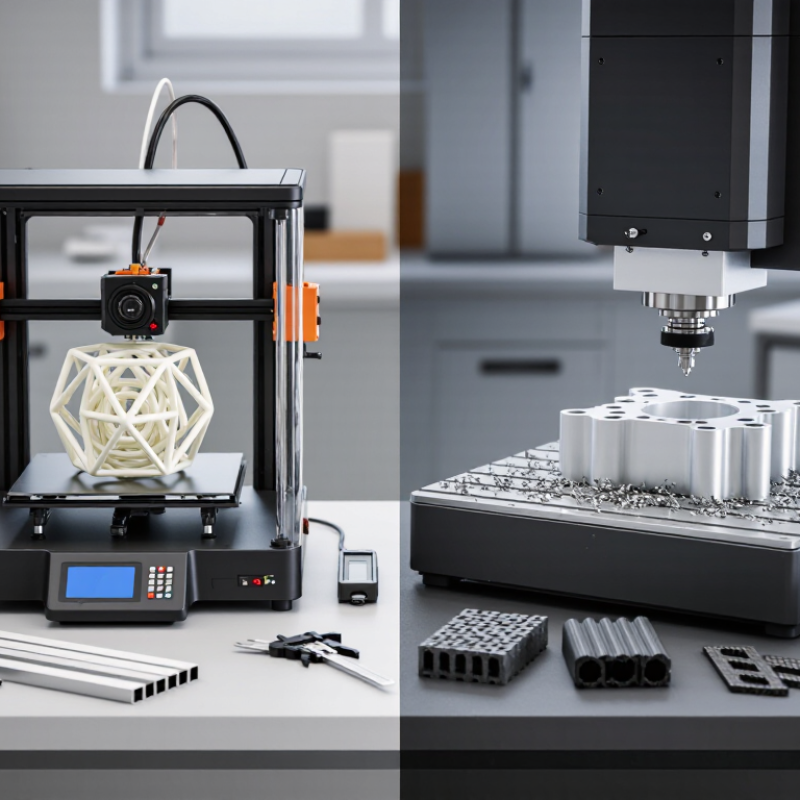
Choosing between 3D printing and CNC machining begins with understanding how each process creates a part. 3D printing adds material layer by layer, following a digital model. CNC machining removes material from a solid block with controlled cutting tools. This difference affects accuracy, strength, cost, and design freedom.

In practical workshop testing, 3D printing works well for prototypes, lightweight structures, and complex internal channels. It can produce shapes that traditional tools cannot easily reach. However, printed layers may create visible lines and weaker bonding between directions. CNC machining usually provides tighter tolerances, smoother surfaces, and more predictable mechanical performance. It suits functional parts, precise holes, and durable metal components. It was slower.

Material choice also changes the decision. A printed polymer housing may be inexpensive and quick to revise. A machined aluminum bracket can better resist heat, pressure, and repeated loading. Still, this rule is not perfect. Some advanced printed materials perform reliably, while poorly planned machining can waste significant material.

Part quantity matters too. For a single fitting, 3D printing may reduce setup time. For repeated production, CNC machining can become more efficient after fixtures and toolpaths are prepared. Geometry remains important. 3D printing accepts organic curves and hollow forms, while CNC machining needs tool access and suitable cutting angles. I once favored printing for a tight-tolerance assembly and underestimated post-processing. The part looked correct, but its mating surface needed additional machining.
Comparing Materials, Part Geometry, and Design Constraints

How to Choose Between 3D Printing and CNC Machining?

Comparing Materials, Part Geometry, and Design Constraints

Material choice often decides the process before geometry does. CNC machining supports metals, engineering plastics, and composites with predictable mechanical performance. It suits aluminum brackets, steel shafts, and parts needing tight interfaces. 3D printing offers polymers, resins, and metal powders, but each process changes strength, surface texture, and heat resistance. According to the Wohlers Report 2024, additive manufacturing reached $20.035 billion globally in 2023, growing 13.5% year over year. That growth reflects practical adoption, not universal replacement.

Geometry can reverse the decision. A CNC tool needs access, clearance, and a cutting path. Deep internal channels, thin ribs, and complex cavities may require several setups. 3D printing can create lattice structures, curved ducts, and integrated hinges with fewer assemblies. However, support removal may mark a visible surface. Printed parts can also vary between build directions. Small details matter.

Design constraints remain decisive. CNC often provides stronger dimensional repeatability for mating holes and flat sealing faces. Additive manufacturing reduces material waste and supports rapid design changes. The U.S. Department of Energy reports that machining can waste 50–70% of original material in some operations. That figure depends heavily on the part and stock shape. It should not become a shortcut for every decision.

A prototype may expose weaknesses.

I have seen lightweight printed housings fail around screw bosses. A machined version survived, but cost more and arrived later. The better choice depends on load, volume, tolerance, inspection needs, and finishing requirements—not fashion.

Evaluating Accuracy, Surface Finish, and Mechanical Performance

How to Choose Between 3D Printing and CNC Machining?

Accuracy often decides the process before cost does. CNC machining can hold tight tolerances on metal parts and stable engineering plastics. A drilled hole may stay within a few hundredths of a millimeter when tooling, fixturing, and material are controlled. 3D printing depends more on layer height, orientation, shrinkage, and machine calibration. Fine features can look accurate but still vary inside the part. Measure critical areas with calipers, gauges, or a coordinate measuring machine.

Surface finish reveals another practical difference. CNC-cut surfaces usually show predictable tool marks, especially on flat faces and turned diameters. A light finishing pass can improve them further. Printed parts may show visible layers, support scars, or slight stepping on curved walls. Smaller layers help, but they increase production time. The surface can fool the eye.

Mechanical performance needs more caution. A machined part is generally uniform through its material, while a printed part may be weaker between layers. Load direction matters greatly.

I once saw a visually perfect bracket fail along its layer lines because the print orientation was chosen for appearance.

That mistake was avoidable. Heat, moisture, fatigue, and chemical exposure also affect the result. For a strong, repeatable component, compare test data under the real operating conditions, not only a supplier’s headline strength. Sometimes a hybrid approach works best: print the complex body, then machine the mating surfaces.

Estimating Costs, Production Volume, and Manufacturing Time

Choosing between 3D printing and CNC machining depends heavily on cost, production volume, and manufacturing time. For a small batch, 3D printing often reduces setup expenses and avoids custom tooling. It can produce complex shapes within hours, especially when parts need internal channels or lightweight structures. CNC machining may cost more initially because programming, fixtures, and material preparation add labor. However, it can provide tighter tolerances and a smoother surface.

Tips: Request quotes using the same material, quantity, tolerance, and finishing requirements. Separate one-time costs from the unit price. Ask how long setup, production, inspection, and shipping will take. A simple spreadsheet can expose hidden costs.

For higher volumes, CNC machining may become more economical because setup costs spread across many parts. Its cycle time is also easier to predict after testing. 3D printing remains useful when designs change frequently or demand is uncertain.

Yet estimates are not perfect. A failed print, tool wear, support removal, or extra sanding can alter both price and schedule. I usually compare three scenarios: one prototype, ten parts, and the expected annual volume. This reveals where the cost curve changes. A printed part may be ready tomorrow but need careful finishing. A machined part may take longer to program but arrive ready for assembly. Check the final use, not only the quoted price.

Selecting the Best Process for Your Specific Application

How to Choose Between 3D Printing and CNC Machining?

Selecting the best process starts with the application, not personal preference. A lightweight housing with internal channels may suit 3D printing. Complex shapes can be produced without expensive cutting tools or extensive setup. However, printed parts may show layer lines, anisotropy, or dimensional variation. These issues matter when sealing surfaces or moving components are involved.

CNC machining often provides tighter tolerances, smoother surfaces, and dependable material properties. It fits functional parts, shafts, brackets, and low-volume components requiring strength. Yet, machining can waste material and struggle with hidden cavities or thin features. My first choice is not always correct. A prototype that looked ideal in plastic failed after heat exposure. The material decision needed more attention than the machine.

Tips: Define the load, temperature, surface finish, and tolerance before selecting a process. Sketch the most critical dimensions. Ask whether the part needs production-grade repeatability or only a fast design check. For small batches, compare setup time, post-processing, and inspection costs. Test one sample under real operating conditions. A printed prototype can validate fit, while a machined version confirms final performance. Also, question your assumptions. The cheapest quote may become expensive after supports, finishing, rejected parts, or redesigns. Reliable decisions come from measured requirements, clear drawings, and honest testing.

How to Choose Between 3D Printing and CNC Machining? — Selecting the Best Process for Your Specific Application
Decision Factor 3D Printing CNC Machining Best-Process Guidance
Manufacturing Principle Additive
Builds a part layer by layer from a digital model, allowing material to be placed only where needed.
Subtractive
Removes material from a solid workpiece using rotating tools and controlled cutting paths.
Choose additive manufacturing for material-efficient, highly customized parts. Choose CNC machining when the starting stock, rigidity, and finished surfaces are priorities.
Typical Materials Thermoplastics, photopolymers, fiber-reinforced polymers, selected metals, and certain ceramic-based materials. Material choice depends strongly on the printing technology. Aluminum, steel, stainless steel, brass, copper, titanium, engineering plastics, composites, and many other machinable materials. CNC generally offers a broader selection of production-grade metals. 3D printing is attractive when polymer customization or specialized printed materials is sufficient.
Dimensional Accuracy Common polymer processes often achieve approximately ±0.1 to ±0.3 mm for many small parts, although size, orientation, material, and machine type affect the result. Many CNC operations can achieve approximately ±0.025 to ±0.125 mm on suitable features with appropriate tooling, workholding, and process control. Use CNC for tight fits, bearing seats, precision bores, and controlled mating interfaces. Use 3D printing when functional tolerances are less demanding.
Surface Finish May show visible layer lines, stair-stepping, or support marks. Smoothing, sanding, coating, tumbling, or machining may be required. Produces predictable machined surfaces. Finish depends on tool geometry, cutting parameters, material, and the required machining operation. Choose CNC when appearance, sealing surfaces, sliding surfaces, or low roughness are important without extensive post-processing.
Geometric Complexity Excellent for internal channels, lattice structures, topology-optimized forms, organic shapes, and part consolidation, subject to support and powder-removal limits. Excellent for prismatic features, holes, pockets, flats, threads, and accessible contoured surfaces. Deep cavities and undercuts may require additional setups or specialized tools. Choose 3D printing for complex geometries that are difficult or impossible to cut. Choose CNC for accessible, tool-friendly geometry.
Prototype Lead Time Often fast for one-off parts because tooling is usually unnecessary. Design changes can be implemented directly in the digital file. Can be fast for simple parts, but programming, stock preparation, workholding, tool selection, and finishing add setup requirements. 3D printing is usually preferable for early design iterations and low-volume prototypes, especially when geometry changes frequently.
Production Volume Economical for one-off parts, customized products, and low-volume production where avoiding dedicated tooling is valuable. Often becomes more competitive as quantities increase, particularly for repeatable parts with stable designs and efficient machining strategies. For recurring production, compare total cost per part, cycle time, post-processing, inspection, and material utilization rather than unit price alone.
Design Flexibility High flexibility: design changes generally require file updates rather than new cutting tools or dedicated molds. Moderate flexibility: most changes are possible, but they may require new programs, tools, workholding, or additional machining operations. Choose 3D printing when customization or frequent design revision is central to the application.
Mechanical Properties Properties may vary by build direction, layer bonding, infill, porosity, thermal history, and post-processing. Anisotropy can be significant. Parts are generally homogeneous relative to the selected stock, with properties influenced by material grade, heat treatment, grain direction, and machining effects. Choose CNC for highly predictable strength, fatigue performance, impact resistance, and load-bearing interfaces unless the printed process is specifically qualified.
Material Utilization Usually produces less initial waste because material is deposited only where required, although supports, failed builds, purge material, and powder handling can add waste. Generates chips and scrap from the workpiece. Efficient nesting and chip recycling can reduce the environmental and material impact. 3D printing is advantageous for lightweight structures and material-saving designs. CNC may still be preferable when the required stock volume is small or recycling systems are available.
Post-Processing May require support removal, washing, curing, heat treatment, depowdering, sanding, coating, or surface machining. May require deburring, washing, heat treatment, anodizing, plating, painting, or other finishing operations. Include all post-processing steps when comparing cost, lead time, dimensional control, and labor requirements.
Part Size and Build Constraints Limited by the printer’s build volume, allowable overhangs, thermal behavior, warping risk, and the need to orient the part correctly. Limited by machine travel, work envelope, tool reach, workholding, rigidity, and the ability to access each surface. Compare the actual part envelope and feature accessibility with the available equipment before selecting a process.
Threads and Precision Interfaces Large, coarse threads and low-load interfaces can be printed, but fine threads and tight fits may require inserts or secondary machining. Threads, reamed holes, bearing seats, and precision mating surfaces can be produced directly with suitable tools and inspection. Choose CNC when threaded connections, repeatable fits, or precision alignment are critical.
Tooling and Setup Cost Usually requires no dedicated cutting tool or mold. Supports, fixtures, build plates, and post-processing equipment may still be needed. Requires cutting tools, workholding, fixturing, programming, and sometimes multiple setups. Dedicated tooling may improve repeatability for repeated jobs. 3D printing generally minimizes upfront setup for customized or low-volume parts. CNC setup can be justified by precision and repeat production.
Recommended Application Examples Concept models, ergonomic prototypes, custom fixtures, lightweight brackets, internal ducting, low-volume replacement parts, and complex consolidated components. Precision housings, shafts, brackets, manifolds, molds, tooling components, machine elements, and parts requiring durable metal performance. Base the final decision on required tolerance, material performance, geometry, quantity, inspection needs, and complete delivered-part cost.
Important: The capability ranges shown are typical engineering guidelines rather than guarantees. Actual results depend on the specific printing or machining technology, equipment, material, part size, geometry, orientation, tooling, operator, and quality-control requirements.