
Global buyers are reassessing Quick Connect Fittings as factories demand faster maintenance and more dependable fluid control. Grand View Research reports that the global quick couplings market was valued at approximately USD 1.9 billion in 2023, with continued growth expected through 2030. MarketsandMarkets also identifies industrial automation, construction equipment, and fluid handling as major demand areas. These figures vary between research firms, but the direction is clear.
Small components matter.
A reliable fitting can reduce hose replacement time, prevent contamination, and support safer equipment servicing. However, selecting a Fitting Quick Connect only by thread size can create costly problems. Buyers must examine pressure ratings, temperature limits, media compatibility, flow requirements, sealing materials, and connection standards. A stainless-steel coupling may suit corrosive washdown areas, while a lightweight polymer model may serve pneumatic tools more efficiently. The correct choice depends on the working environment, not just the catalogue price.
This guide reviews the top types of quick connect fittings used by global purchasers, including pneumatic couplings, hydraulic quick couplers, camlock fittings, push-to-connect designs, and dry-break connectors. Data from the International Organization for Standardization and industry manufacturers such as Parker Hannifin and Swagelok reinforces the importance of standardized dimensions, tested materials, and documented performance. Still, manufacturer claims require careful verification. Product labels can sound impressive. Field conditions are less forgiving.
Buyers should compare test certificates, traceability, replacement availability, and regional compliance before ordering. A fitting that works perfectly in a clean workshop may fail near abrasive dust, vibration, or aggressive chemicals. This practical gap deserves attention when building a dependable international sourcing strategy.
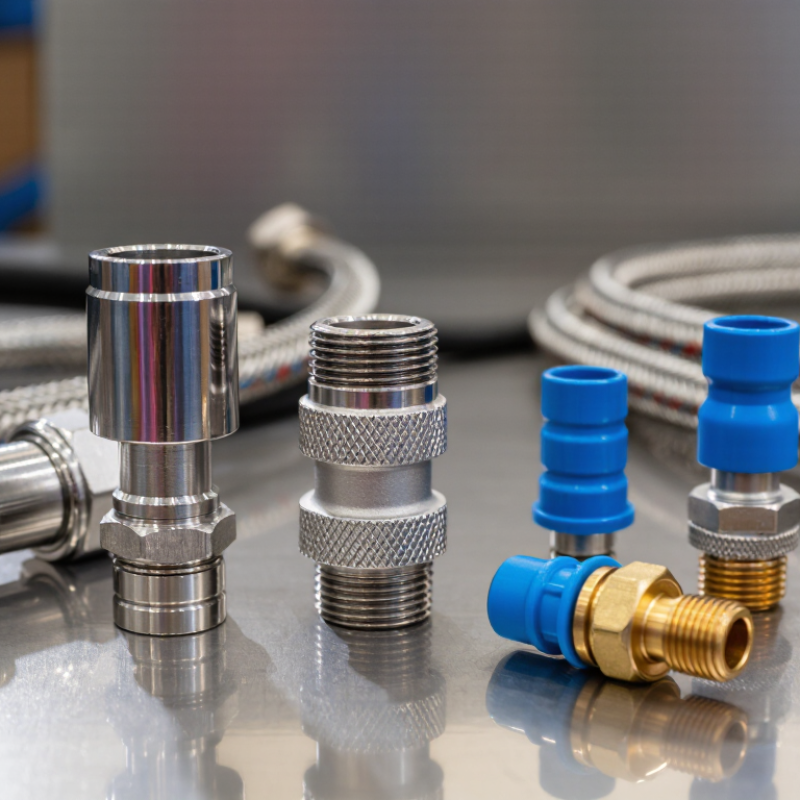
Quick-connect fittings are not interchangeable by appearance alone. ISO 7241 covers hydraulic quick couplings with defined dimensional and performance requirements. Series A commonly supports agricultural and general industrial equipment. Series B suits broader industrial applications. Buyers should verify size, pressure, sealing material, and connection profile before ordering.
ISO 16028 defines flat-face couplings for cleaner hydraulic service. Their flush design reduces fluid loss and limits contamination during connection. This matters on mobile machinery, where dust can enter an open coupling within seconds.
ISO 14541 addresses screw-to-connect couplings for demanding hydraulic circuits. These fittings resist pressure separation, but they usually require more connection time. That trade-off is often overlooked.
Industry forecasts show why specification discipline matters. MarketsandMarkets projects the hydraulic equipment market to grow from about USD 49 billion in 2023 to more than USD 63 billion by 2028. The Freedonia Group also identifies replacement demand as a major driver in industrial fluid handling. More equipment means more mixed inventories and greater mismatch risk. Standards reduce uncertainty, but they cannot replace dimensional checks. A fitting may meet ISO 16028 and still fail because its working pressure, temperature range, or elastomer is unsuitable. Field inspection should include thread measurements, face condition, locking sleeves, and visible leakage. Small errors become expensive quickly. Test procedures also deserve review; published ratings may assume clean oil, controlled temperature, and ideal installation.

Quick connect fittings serve different pressure and temperature demands. Standard hydraulic couplers often handle 250–420 bar in demanding machinery. Screw-to-connect designs can reach about 700 bar when correctly installed. Ultra-high-pressure couplers may support up to 1,000 bar, but only with compatible hoses, seals, and connection procedures. Ratings are not universal. Always check the supplier’s pressure-temperature chart.
At 300°C, material selection becomes critical. Stainless steel bodies resist heat and corrosion, while seal compounds must match the fluid and operating temperature. Metal-to-metal sealing can suit extreme heat, although it may require cleaner alignment and higher connection force. Flat-face couplers reduce contamination during maintenance. Poppet couplers can offer strong flow performance, but trapped pressure may complicate disconnection. A pressure rating without a temperature correction can mislead buyers.
Tips: Confirm working pressure, burst pressure, flow rate, and allowable temperature separately. Inspect threads, locking sleeves, and sealing surfaces before every installation. Test the complete assembly gradually, not at full pressure immediately. Keep a record of fluid type and service temperature. Small details matter here. In practice, engineers sometimes choose a higher-rated coupler and still overlook hose movement or thermal expansion. That mistake deserves review.
Top Types of Quick Connect Fittings for Global Buyers
Material selection should follow the working medium, pressure, temperature, and installation environment. Stainless steel fittings suit water, aggressive chemicals, and humid service. Brass is practical for compressed air and clean water lines. Carbon steel handles demanding oil systems, but it needs corrosion protection. Engineered polymers reduce weight and may suit low-pressure chemical transfer.
The seal often decides whether a connection remains dependable. NBR works well with air, mineral oils, and hydraulic fluids. EPDM performs better with water, steam, and selected mild chemicals, but it should not contact petroleum oils. FKM tolerates higher temperatures and many oils, although some chemicals still attack it. PTFE offers broad chemical resistance, but its limited elasticity can make sealing more sensitive. Silicone suits clean, flexible applications, not every high-pressure service.
Ball-lock couplings allow fast tool changes on air lines. Cam-and-groove couplings support larger hoses for water, oil, and some chemicals. Threaded quick connectors provide compact, secure assemblies where vibration is controlled. Gas service requires careful attention to leakage, ignition risk, and approved pressure ratings. A fitting rated for water is not automatically safe for gas. That assumption causes expensive mistakes. Compatibility tables are useful, but they cannot replace checking concentration, temperature, pressure spikes, and seal wear. Real installations are rarely perfect. A small particle on the sealing face can defeat an otherwise suitable connection.
| Quick Connect Fitting Type | Typical Connection Design | Common Body Materials | Common Seal Options | Suitable Media | Typical Pressure Capability* | Typical Temperature Range* | Main Advantages | Important Selection Considerations |
|---|---|---|---|---|---|---|---|---|
| Industrial Poppet Coupling | Single-shutoff or double-shutoff poppet with sleeve-locking mechanism | Plated carbon steel, stainless steel, brass | NBR, FKM, EPDM, polyurethane | Compressed air, hydraulic oil, water, general-purpose fluids | Approximately 10–35 MPa, depending on size, material, and series | Approximately −20°C to 150°C, depending on seal compound | Widely available, simple operation, good general industrial performance | Confirm coupling profile, flow capacity, residual pressure limits, and compatibility with the fluid |
| High-Flow Sleeve Coupling | Large internal passage with sleeve-operated locking balls or locking segments | Steel, stainless steel, aluminum | NBR, FKM, EPDM | Air, water, low-viscosity oils, coolants | Approximately 1–25 MPa, depending on design | Approximately −40°C to 150°C, depending on materials | Lower pressure drop and higher flow than many conventional couplings | Check flow-rate data, hose size, connection cleanliness, and resistance to external impact |
| Flat-Face Hydraulic Coupling | Flush mating faces with minimal fluid spillage during disconnection | Hardened steel, stainless steel | NBR, FKM, EPDM | Hydraulic oil, water-glycol fluids, selected biodegradable hydraulic fluids | Approximately 20–40 MPa, depending on size and series | Approximately −25°C to 150°C, depending on seal material | Low air inclusion, reduced leakage, easy cleaning, suitable for mobile hydraulics | Use only with matching flat-face halves; verify impulse, vibration, and working-pressure ratings |
| Screw-to-Connect Coupling | Threaded sleeve or union nut mechanically joins the two halves | Carbon steel, stainless steel | NBR, FKM, EPDM, PTFE-backed designs | High-pressure oil, water, gas, and demanding hydraulic circuits | Approximately 25–70 MPa, depending on design and size | Approximately −40°C to 200°C, depending on seal and body material | Resists vibration and accidental uncoupling; suitable for high-pressure service | Connection and disconnection are slower; do not force the thread under residual pressure |
| Dry-Break Coupling | Valved coupling designed to minimize leakage and air entry during separation | Stainless steel, aluminum, polypropylene, fluoropolymer-lined alloys | FKM, EPDM, FFKM, PTFE, NBR | Fuels, solvents, chemicals, paints, pharmaceutical fluids, oils | Approximately 0.5–10 MPa, depending on size and construction | Approximately −40°C to 200°C, depending on seal and lining | Very low spillage, reduced vapor release, improved operator and environmental protection | Material compatibility is critical; verify chemical concentration, permeation, and cleaning requirements |
| Cam-and-Groove Coupling | Cam arms engage an adapter without tools; generally not intended for connection under pressure | Stainless steel, aluminum, brass, polypropylene, reinforced composites | NBR, EPDM, FKM, PTFE, silicone | Water, agricultural chemicals, fuels, powders with suitable hose systems, low-pressure oils | Commonly approximately 0.7–1.6 MPa, depending on size and material | Approximately −40°C to 200°C, depending on material and seal | Fast tool-free connection, broad size range, convenient for transfer hoses | Not normally recommended for compressed gas or high-pressure hydraulic service; secure cam arms against accidental opening |
| Pneumatic Plug-and-Socket Coupling | Plug inserted into a spring-loaded socket with sleeve or push-button release | Nickel-plated steel, brass, stainless steel, engineered polymer | NBR, FKM, EPDM | Compressed air, inert gases, vacuum service when specifically rated | Commonly approximately 0.8–1.6 MPa for industrial air service | Approximately −20°C to 120°C, depending on seal and polymer components | Quick operation, compact form, suitable for tools and air lines | Use the correct profile and flow series; confirm gas compatibility, pressure, and disconnection safety |
| Push-to-Connect Tube Fitting | Collet and gripping ring retain tubing; tube is released by pressing the collar | Acetal, brass, stainless steel, PPS, nickel-plated brass | NBR, EPDM, FKM, silicone | Instrument air, water, inert gases, low-pressure process fluids | Commonly approximately 0.6–2.0 MPa, depending on tube size and temperature | Approximately −20°C to 150°C, depending on body, tube, and seal | Fast installation, no threading or flaring, compact routing | Use tubing with the correct outside diameter and hardness; cut the tube square and fully insert it |
| Subsea or Underwater Coupling | Pressure-balanced or wet-mate design with robust locking and sealing features | Duplex stainless steel, marine-grade stainless steel, titanium, engineered polymers | EPDM, FKM, NBR, polyurethane, specialized thermoplastic seals | Hydraulic fluids, seawater-compatible fluids, monitoring and control fluids | Varies widely; commonly approximately 1–70 MPa depending on depth and design | Often approximately −20°C to 120°C, depending on depth and materials | Designed for difficult environments, corrosion resistance, and underwater connection | Verify depth rating, pressure compensation, galvanic corrosion control, and fluid compatibility |
| Chemical-Resistant Fluoropolymer-Lined Coupling | Valved or dry-break coupling with chemically resistant internal wetted surfaces | PTFE-lined stainless steel, PFA-lined metal, PVDF, polypropylene | PTFE, FKM, EPDM, FFKM | Acids, alkalis, solvents, aggressive cleaning agents, specialty chemicals | Commonly approximately 0.5–4 MPa, depending on lining and temperature | Approximately −20°C to 200°C, depending on polymer and seal system | High chemical resistance and reduced contamination of sensitive fluids | Check chemical concentration, temperature, permeation, static discharge, and pressure derating |
| Gas-Service Quick Coupling | Self-sealing valve arrangement with locking sleeve and gas-rated connection profile | Brass, stainless steel, plated steel | FKM, NBR, EPDM, PTFE | Air, nitrogen, carbon dioxide, argon, oxygen when specifically approved | Commonly approximately 0.5–25 MPa, depending on gas and construction | Approximately −40°C to 150°C, depending on seal and body material | Fast gas-line connection and reduced leakage when correctly selected | Oxygen service requires dedicated cleaning and approval; never assume a liquid-service coupling is gas-rated |
| Thermoplastic Hose Coupling | Barbed, push-on, or locking connection designed for flexible polymer hose | Polypropylene, PVDF, nylon, acetal, brass, stainless steel | EPDM, FKM, silicone, NBR | Water, air, chemicals, laboratory fluids, low-pressure oil systems | Commonly approximately 0.3–3 MPa, depending on hose and temperature | Approximately −40°C to 150°C, depending on polymer and seal | Lightweight, corrosion-resistant options available, easy to integrate into compact systems | The hose, fitting, clamp, temperature, and chemical exposure must be rated as one complete assembly |
*Pressure and temperature figures are typical industry ranges rather than universal ratings. Actual limits depend on fitting size, connection profile, body material, seal compound, hose or tube, fluid, temperature, vibration, and applicable safety standards. Always use the manufacturer’s current technical data for final selection.
Sizing quick-connect fittings starts with the real medium, not the catalog label. DN6 to DN50 describes nominal size, while the internal bore may differ considerably. For clean water at 20°C, a practical velocity range of 2–3 m/s gives approximate flow rates: DN6, 3–5 L/min; DN10, 9–14 L/min; DN13, 16–24 L/min; DN19, 34–51 L/min; DN25, 59–88 L/min; DN32, 96–145 L/min; and DN50, 236–353 L/min. These figures are engineering estimates, not guaranteed fitting capacities.
Pressure loss depends on the valve poppet, spring, seals, coupling profile, and hose connection. ISO 7241 testing principles require flow and pressure-drop evaluation for hydraulic quick couplings, while ISO 4414 provides pneumatic system guidance. In practice, a DN6 coupling may lose 0.1–0.4 bar near its working flow. A DN25 unit can show similar loss only when heavily restricted. Small passages punish poor sizing.
The U.S. Department of Energy’s compressed-air guidance recommends keeping distribution pressure drop below 10% of working pressure. That target is useful, but it can mislead when several couplings are installed in series. Count every connection. For a DN19 hydraulic line carrying 45 L/min, one restrictive coupling may create a noticeable temperature rise and slower actuator movement. I would verify the actual bore and test pressure loss under operating flow, because nominal DN alone is an imperfect shortcut.
Sizing Quick-Connect Fittings: DN6–DN50, Flow Rates, and Pressure Loss
This engineering reference compares nominal bore sizes using clean water at approximately 3 m/s flow velocity. Flow capacity is calculated from the nominal internal diameter, while pressure loss represents an indicative loss across a typical quick-connect flow path. Actual results vary with valve design, seals, coupler geometry, fluid viscosity, and operating conditions.
Quick-connect fittings must match the buyer’s thread system, pressure needs, and compliance duties. BSP threads, defined by ISO 228-1, are common across Europe and many international markets. NPT threads follow ASME B1.20.1 and use a tapered sealing design. SAE threads, including SAE J514 connections, often serve hydraulic equipment. They are not interchangeable.
Check thread type, pitch, gender, sealing method, and working pressure. ISO 7241 and ISO 16028 provide useful references for hydraulic quick couplings. The ISO Survey 2022 recorded 1,265,216 ISO 9001 certificates across 189 economies. This shows strong global demand for controlled quality systems, but certification alone does not guarantee fitting performance. Request material records, pressure-test results, traceability documents, and current certificates. A checklist can still miss installation errors.
Tips: Confirm whether the fitting seals on threads, an O-ring, or a metal face. Never judge compatibility by appearance. CE marking applies only when relevant European Union legislation requires it. It is not a general quality award. The European Commission’s Blue Guide explains that manufacturers must complete conformity assessment and retain technical documentation. Ask for the Declaration of Conformity, applicable directives, and product identification. Test the actual hose and coupling combination under realistic temperature and pressure. In practice, buyers sometimes overlook contamination control, which can damage valves quickly. That small oversight becomes expensive.

© Copyrights Levil Technology Corp 2022