Top Spindle Hub Bearing Assembly Manufacturers
The Spindle Hub Bearing Assembly market sits where precision engineering meets road safety. Mordor Intelligence estimates the global automotive wheel bearing market at about USD 9.5 billion in 2025, with continued growth expected through 2030. Grand View Research also identifies rising vehicle production, stricter efficiency targets, and demand for integrated bearing units as major growth drivers. These figures matter to manufacturers, but they do not tell the whole story.
A strong Spindle Hub Bearing Assembly must survive more than rotation. It faces radial loads, cornering forces, braking heat, water intrusion, and uneven road shock. A small sealing defect can become visible as noise, vibration, or premature hub play. Dr. Stefan Spindler, a senior Schaeffler industry executive, has emphasized a practical engineering principle: “A bearing is only as reliable as its application, mounting, and maintenance.” That warning deserves attention.
This guide examines leading manufacturers through product design, metallurgy, sealing systems, quality controls, and testing capability. It also considers service experience, not only catalog specifications. Companies may claim long life, yet field performance can vary with torque accuracy, installation tools, lubricant control, and vehicle duty cycles. That is an uncomfortable gap.
Manufacturers with strong laboratory results may still struggle in harsh fleets. Others may offer quieter operation but weaker supply continuity. Readers should therefore compare published evidence, independent testing, warranty data, and regional support. The best supplier is rarely the loudest one. Reliability needs proof.
What Is a Spindle Hub Bearing Assembly?
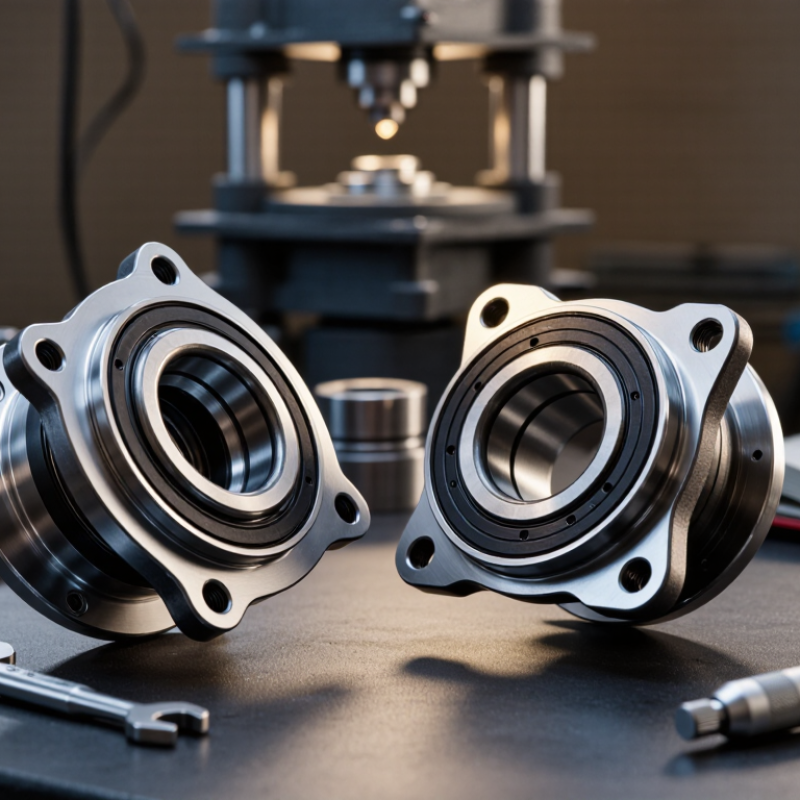
A spindle hub bearing assembly is a wheel-end unit that supports the vehicle’s weight and allows the wheel to rotate smoothly. It connects the wheel hub to the steering knuckle or spindle. Inside, hardened races and rolling elements carry radial and side loads during driving, cornering, and braking. Many assemblies also include a flange, seal, mounting studs, or an integrated speed sensor.
In workshop inspections, I have seen small installation errors create large problems. The mating surfaces must be clean and flat. Rust or trapped debris can tilt the assembly slightly, causing uneven bearing stress. Correct axle-nut torque is equally important. Too much torque may damage internal components, while too little can create looseness and noise. Quiet operation matters.
Listen for humming that changes with vehicle speed. Check for wheel play, rough rotation, damaged seals, or unusual heat after a road test. A damaged assembly may also affect sensor readings and braking-system warnings. However, noise diagnosis is not always simple. Tire wear, suspension joints, and drivetrain parts can produce similar sounds. This is where careful comparison helps. A reliable manufacturer should document material quality, load testing, dimensional control, and sealing performance. I would still inspect every replacement part before installation, because specifications on paper cannot reveal every handling or storage problem.
Key Design Features and Performance Standards
Top spindle hub bearing assembly manufacturers distinguish themselves through controlled preload, accurate geometry, and stable material quality. ISO 281 defines L10 life as the point where 90% of identical bearings are expected to survive. For ball bearings, the calculation uses a cube relationship between dynamic load rating and applied load. A doubled load can reduce calculated life to nearly one-eighth. That figure is sobering.
ISO 492 dimensional classes help control bore, outside diameter, and radial runout. In practical inspection, even small runout can create steering vibration through the spindle. Effective assemblies also need multi-lip seals, consistent grease fill, and corrosion-resistant raceways. ISO 15243 failure classifications connect common damage patterns with contamination, electrical pitting, poor lubrication, and excessive loading. The details matter. A seal that looks perfect may still leak after thermal cycling.
Professional wheel-end testing often combines torque measurement, endurance cycling, temperature monitoring, and vibration analysis. The ISO 281 model is useful, but it cannot fully predict road grit, water spray, impact loading, or installation mistakes. That limitation deserves attention. Manufacturers should publish measured runout, preload variation, seal performance, and traceability results, rather than offering only a theoretical service-life number. ISO 9001-based process controls improve reliability, yet inspection data must still be reviewed by skilled engineers. Cheap consistency is not real consistency.
Top Spindle Hub Bearing Assembly Manufacturers: Key Design Features and Performance Standards
ISO 281 basic rating life comparison based on the load-ratio relationship. Values represent millions of revolutions at an equivalent dynamic load ratio of C/P, where C is the basic dynamic load rating and P is the equivalent dynamic bearing load.
ISO 281 Rating Life For ball bearings, L10 = (C/P)³. For roller bearings, L10 = (C/P)10/3. L10 represents the life at which 90% of an identical bearing population is expected to survive under defined conditions.
ISO 492 Accuracy Dimensional and running-accuracy classes support controlled spindle runout, consistent fits, and repeatable hub assembly performance.
Key Design Priorities Preload control, integrated seals, optimized raceway geometry, heat-treated rings, low-friction lubrication, and contamination resistance are central design considerations.
How to Evaluate Spindle Hub Bearing Assembly Manufacturers
Choosing spindle hub bearing assembly manufacturers requires more than comparing unit prices. In practical audits, inspect grinding rooms, clean assembly zones, and end-of-line testing. Ask for radial-load, torque, noise, temperature, and seal-leakage records from recent lots. A supplier should identify steel heat numbers, press-fit tolerances, lubricant batches, and operator shifts. Traceability must reach one finished assembly. That matters when a field failure appears months later. ISO 9001 certification helps, but it does not prove bearing performance. Request independent test evidence aligned with ISO 15243 failure classifications. Small detail. Often missed.
Use published market evidence carefully. Grand View Research’s 2024 automotive bearings report estimates the sector at about USD 39 billion in 2023. It forecasts roughly 6% annual growth through 2030. Growth can hide weak suppliers. Rising demand does not guarantee stable metallurgy or process control. Compare capability data, not brochures: Cp and Cpk values, defect history, warranty returns, and peak-month capacity. Also review IATF 16949 compliance, layered process audits, calibration intervals, and corrective-action closure times. Request sample assemblies, then measure preload, rotational drag, runout, and bolt torque in your own lab. Do not accept a perfect sample as proof. My evaluation would score technical controls above presentation quality, though that judgment may overvalue paperwork. Recheck it with destructive testing, customer references, and a controlled pilot order. A reliable manufacturer explains failures plainly, including uncomfortable ones.
Leading Manufacturer Categories and Production Capabilities
Top Spindle Hub Bearing Assembly Manufacturers
Leading manufacturers usually fall into three categories: integrated bearing producers, precision machining specialists, and contract assembly factories. Integrated producers control forging, heat treatment, grinding, sealing, and final assembly under one system. This can improve consistency. Precision machining specialists focus on hub flanges, races, and spindle interfaces. They often use CNC lathes, automated gauging, and coordinate measuring machines. Contract assemblers support flexible volumes, custom packaging, and regional supply needs. Their strength is responsiveness, but process depth may vary.
Production capability matters more than catalog size. A reliable facility should show controlled heat treatment, clean assembly rooms, calibrated torque tools, and traceable inspection records. Look for measurements covering radial runout, flange flatness, preload, noise, and rotational torque. Some plants use automated end-of-line testers for vibration and seal performance. Others depend heavily on manual checks. That is not always wrong, but it increases variation. A practical audit should examine raw material certificates, batch identification, grease filling accuracy, and corrective-action history. Experienced manufacturers can explain failure patterns, not merely quote tolerances. They should also provide samples from normal production, not specially prepared units. One overlooked detail is operator training. Even advanced equipment cannot correct poor handling. Capability claims deserve verification.