China’s Titanium Hemispheric Bolt sector deserves careful examination, not a simple ranking. These fasteners support aerospace panels, pressure systems, medical equipment, and demanding industrial assemblies. Their hemispherical heads can reduce snagging and distribute contact stress across curved surfaces. Titanium also offers low density, strong corrosion resistance, and useful fatigue performance.
Grand View Research valued the global titanium market at approximately USD 27 billion in 2023. Its report projects continued growth through 2030, supported by aerospace and advanced manufacturing demand. The U.S. Geological Survey also identifies aerospace as a major titanium-consuming sector. However, these reports measure titanium broadly, not hemispheric bolts specifically. That distinction matters.
Dr. Matthew J. Donachie, author of Titanium: A Technical Guide, wrote, “Titanium is a relatively new metal.” His work also explains how alloy selection, heat treatment, and manufacturing control influence performance. Buyers should remember this practical point. A polished surface does not prove reliability.
This introduction examines ten Chinese manufacturers through engineering capability, material traceability, machining accuracy, testing, certifications, and export experience. Important details include Grade 5 titanium control, thread quality, head geometry, and dimensional inspection records. Supplier claims still require verification. Some public rankings appear incomplete, and factory information may change. Therefore, this guide should support technical screening, not replace drawings, samples, independent testing, or qualified engineering review.
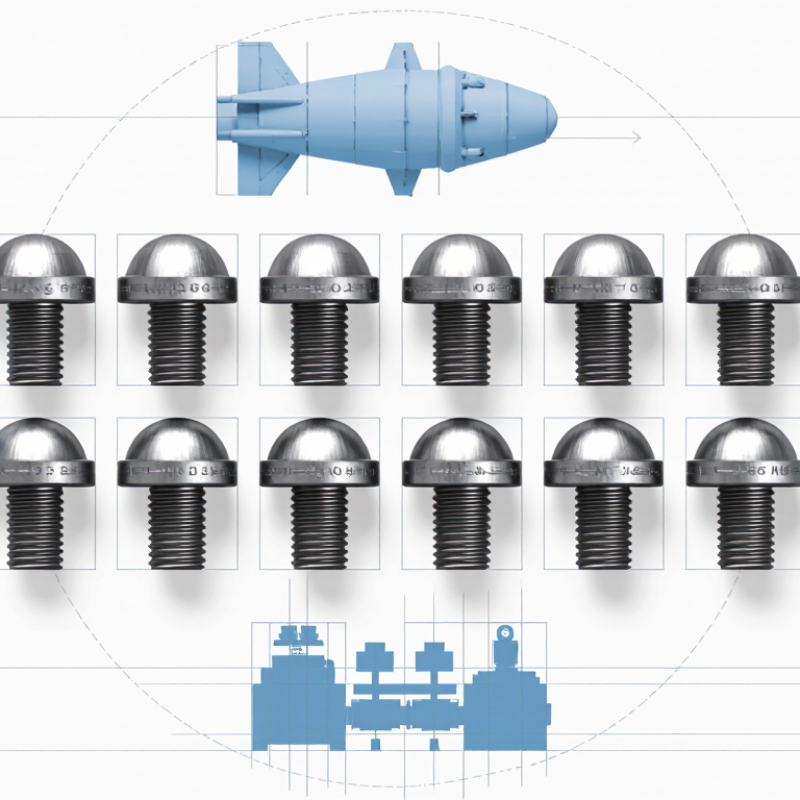
Titanium hemispheric bolts combine a rounded bearing surface with low density and high corrosion resistance. NIST lists commercially pure titanium near 4.51 g/cm³, while Grade 5 titanium is approximately 4.43 g/cm³. That is about 40% lighter than steel, a useful difference in aerospace and marine assemblies.
Strength depends strongly on grade and processing. ASTM B348/B348M data lists Grade 2 titanium with a minimum tensile strength of 345 MPa and yield strength of 275 MPa. Grade 5 titanium reaches approximately 895 MPa tensile strength and 828 MPa yield strength. Grade 23, the extra-low-interstitial variant, commonly provides about 860 MPa tensile strength and 795 MPa yield strength. These values describe the alloy, not every finished bolt.
The shape matters too. A hemispheric head spreads contact gradually and reduces sharp-edge interference. However, poor seating can create local bending and uneven preload. That detail is often underestimated. ISO 898-1 steel comparisons are useful, but they should not replace titanium-specific testing. ASTM F606/F606M recommends mechanical verification for fasteners, including tensile and proof-load evaluation. In practice, thread condition, cold working, heat treatment, and surface contamination can change performance. Published data is a starting point, not a guarantee.

China Top 10 Titanium Hemispheric Bolt Manufacturers
Selecting China’s top ten titanium hemispheric bolt manufacturers requires more than comparing prices. ASTM compliance should be verified through current material certificates, heat numbers, and inspection records. For common titanium grades, buyers often check ASTM specifications for chemistry, mechanical strength, and dimensional control. A reliable factory can explain its testing process clearly. It should also provide traceability from raw bar to finished bolt.
Production capacity matters when orders involve hundreds or thousands of pieces. Ask about forging equipment, CNC capacity, thread rolling, and heat-treatment control. A workshop may claim high output but lack stable quality between batches. That weakness appears in thread fit, head symmetry, or surface marks. Request sample data from recent production. Practical evidence is stronger than a polished catalog.
Lead time should include engineering review, tooling, production, inspection, and export preparation. Stock items may ship quickly, while custom hemispheric heads can require several weeks. Confirm the schedule in writing. Add time for independent inspection when the application is safety-sensitive. Communication is often overlooked. A capable supplier reports delays before the deadline, not after it. I have found that optimistic delivery promises can hide unfinished testing. Buyers should compare actual past performance, not only quoted capacity. Small details matter. Celsius, tolerances, and packaging conditions deserve careful review.
This chart presents an anonymous market benchmark for titanium hemispheric bolt suppliers in China. The comparison uses indicative annual output capacity, average production lead time, and ASTM documentation coverage. Supplier-specific figures should be verified through current quotations, quality records, and third-party inspection.
China’s titanium hemispheric bolt sector depends on disciplined forging, machining, and inspection. The USGS Mineral Commodity Summaries 2024 reported approximately 280,000 metric tons of global titanium sponge production in 2023. China contributed about 150,000 metric tons. This scale supports a broad supply chain, but raw material volume does not guarantee precision.
Forging usually begins with heated titanium bar, controlled below excessive oxidation limits. The process improves fiber flow and reduces internal discontinuities. Operators then remove flash and machine the hemispherical head. CNC turning defines the shank, thread, and seating surface. For ±0.02 mm tolerances, temperature control matters. A small thermal change can shift measurements. Practical shops verify dimensions with calibrated micrometers, thread gauges, and coordinate measuring machines.
The ISO 286-1 system links tolerance grades with nominal size, yet ±0.02 mm is not automatically appropriate for every bolt feature. Engineers should specify datums, surface roughness, and inspection points. ASTM F467 and ASTM F468 provide recognized requirements for nonferrous fasteners, including titanium grades and mechanical properties. Traceability records should connect each bolt to its heat number, forging batch, and inspection report. That sounds basic. It is often missed.
A useful supplier assessment checks grain structure, thread fit, head concentricity, and oxide discoloration after forging. Reports from the International Organization for Standardization emphasize measurement-system control, but production reality remains imperfect. Tool wear, springback, and inconsistent cleaning can still create rejects. A credible manufacturer reports those weaknesses instead of hiding them.
China’s top titanium hemispheric bolt manufacturers should be compared through measurable performance, not catalog claims. Grade 5 titanium, or Ti-6Al-4V, has a minimum tensile strength of 895 MPa under ASTM B348. This value describes the material benchmark, not every finished bolt.
Not automatically superior. Thread rolling, heat treatment, and machining can change performance. A reliable supplier should provide mill certificates, tensile results, hardness data, and dimensional inspection records. In practical audits, thread roots deserve close attention because stress concentration often begins there. Surface contamination from steel tooling can also weaken corrosion resistance.
The ASM Handbook, Volume 13B, describes titanium as highly resistant in seawater and many chloride environments. Its stable oxide film supports long service life. However, crevices, stagnant moisture, reducing acids, and galvanic contact may still create localized attack. Corrosion is selective. Buyers comparing Chinese manufacturers should request salt-spray or immersion test conditions, not only a pass statement. ASTM B117 salt-spray exposure can support screening, but it does not fully reproduce marine service. The 895 MPa figure remains useful, yet it cannot replace fatigue testing, torque-tension checks, and application-specific corrosion evaluation. Some comparisons remain incomplete. That limitation deserves attention.
China Top 10 Titanium Hemispheric Bolt Manufacturers?
When comparing China’s top ten titanium hemispheric bolt manufacturers, verify evidence before reviewing marketing claims. ISO 9001 supports process control, but it does not prove every product meets your requirements. Request current certificates, laboratory reports, and material documentation such as EN 10204 3.1. Check the certificate scope and issuing body. Small details matter.
MOQ can range from 50 pieces for standard bolts to several hundred for customized production. Confirm whether the MOQ applies to each size, grade, or finish. Ask for samples before signing a large order. Measure the dome profile, thread accuracy, head diameter, and surface condition. A sample may pass visually but fail during torque testing.
Customization should cover titanium grade, thread standard, dimensions, tolerances, surface treatment, packaging, and marking. Provide a technical drawing with inspection points. This prevents costly assumptions. Indicative prices may start around 2–8 USD per standard piece and reach 15–60 USD for complex, low-volume designs. These figures change with grade, machining time, testing, and order size. Treat them as negotiation benchmarks, not fixed quotations.
I have found that the lowest quote often hides inspection or tooling costs. Not always. Ask for a complete cost breakdown, production lead time, replacement policy, and pre-shipment inspection records. A dependable supplier answers clearly, admits limitations, and connects claims with verifiable documents.

© Copyrights Levil Technology Corp 2022