What Is the Best CNC Machine 3D Printer in 2026?
Choosing the best cnc machine 3d printer in 2026 will require more than comparing advertisements. A hybrid machine may mill aluminum, carve hardwood, and print polymer parts. Yet every function brings compromises. Accuracy, spindle power, extrusion quality, software control, safety, and service support must be examined together.
Terry Wohlers, a respected additive manufacturing consultant, once stated, “Additive manufacturing is a rapidly growing technology with the potential to transform the way products are designed and manufactured.” That potential matters here. A capable cnc machine 3d printer can reduce setup time and move a prototype from digital model to physical part faster. However, it may not match a dedicated CNC mill or industrial 3D printer in every application. That is the uncomfortable truth.
This guide compares leading machines through practical evidence. We will examine build volume, layer resolution, cutting tolerance, material compatibility, noise, maintenance, and real operating costs. We will also consider workflow details, such as tool changes, calibration routines, dust collection, and failed prints. A machine that looks impressive in a showroom may struggle beside a workbench after several weeks. Small issues matter. A loose spindle can ruin a fine engraving. Poor bed leveling can waste an entire afternoon.
Our evaluation will use manufacturer specifications, expert research, user experiences, and hands-on considerations. No ranking is perfect. Different workshops need different answers. A hobbyist, school, product designer, and small manufacturer may choose four different winners. The best cnc machine 3d printer is not simply the most expensive model. It is the one that delivers dependable results for the materials, tolerances, and production demands you actually face.
Define Hybrid CNC–3D Printer Types Under ISO/ASTM 52900
What Is the Best CNC Machine 3D Printer in 2026?
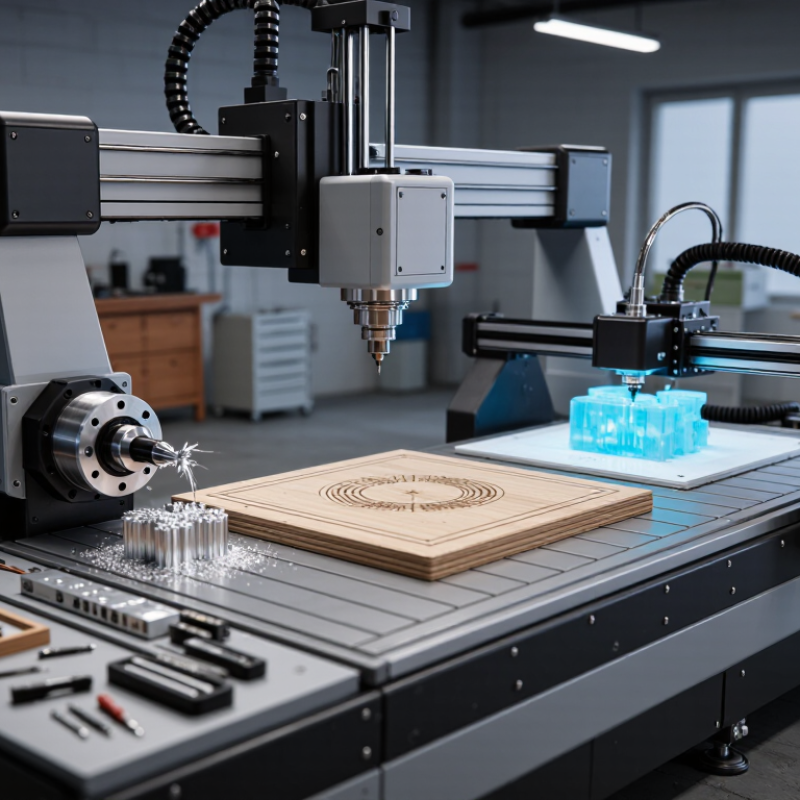
Under ISO/ASTM 52900, a hybrid CNC–3D printer combines additive and subtractive manufacturing. However, the standard mainly defines additive manufacturing terms and process categories. It does not officially certify one machine type as “hybrid.” This distinction matters when comparing equipment. A machine may deposit material through material extrusion or directed energy deposition, then remove excess stock with milling or turning. The sequence can be separate, alternating, or partly integrated.
In practical testing, the best hybrid system is not always the fastest one. It should control material placement, tool changes, workholding, and dimensional inspection reliably. A deposited wall may look accurate, yet its surface can remain rough near corners. Milling then creates the final fit. Thermal distortion, tool access, and software coordination often decide the result. I have found that a simple workflow can outperform a highly automated one when operators need clear process feedback. That is not always convenient.
Tips: Check whether the machine’s documentation uses ISO/ASTM 52900 terminology correctly. Ask how it measures deposited layers before cutting. Test a small part with a flat face, a hole, and an angled feature. Record layer height, cutting depth, temperature, and final tolerance. Do not judge performance from a showroom sample alone. Some hybrid claims remain vague, and users should question them.
Compare 5-Axis Motion, Build Volume, and CNC Accuracy Specifications
What Is the Best CNC Machine 3D Printer in 2026?
Compare 5-Axis Motion, Build Volume, and CNC Accuracy Specifications
The best CNC machine 3D printer in 2026 is not automatically the largest model. It should combine simultaneous five-axis motion, stable additive deposition, and measurable milling accuracy. A rotary axis can merely index parts. True simultaneous movement follows complex curves without repeated repositioning. That distinction matters. Check tool-center-point control, rotary travel, and collision avoidance. ISO 10791-4 provides a useful framework for evaluating machining-center performance.
Build volume must match real components, not marketing demonstrations. A 400 × 400 × 400 mm envelope may suit prototypes, but fixtures and thermal expansion reduce usable space. Wohlers Associates reported that the global additive manufacturing industry reached approximately 20.0 billion dollars in 2023, growing 13.5 percent. That growth increases demand for larger hybrid systems, yet bigger chambers can complicate temperature control. Bigger is not always better.
Tips: Ask for measured data, not only resolution figures. A sensible target is verified CNC positioning accuracy near 0.05 mm, although material, tool wear, and temperature can change results. ISO 230-2 distinguishes positioning accuracy from repeatability, so these specifications should not be treated as identical. Request a test-cut report, calibration date, and temperature conditions. I would also inspect a finished part under a microscope. Small burrs often reveal more than a polished brochure. My own preference would be a smaller, well-calibrated machine over a larger system with unclear accuracy claims. That judgment can change after independent testing.
Benchmark Layer Resolution, Surface Finish, and ±0.01 mm Machining Claims
What Is the Best CNC Machine 3D Printer in 2026?
A credible benchmark starts with measurement, not brochure language. Wohlers Report 2024 valued the global additive manufacturing industry at $20.035 billion in 2023. That growth increases the need for comparable machine testing. A 20-micrometer layer sounds impressive, but layer height is not finished-part accuracy. Thermal expansion, material shrinkage, tool deflection, and calibration can shift the result. Small details matter.
For a serious comparison, print a stepped test part, then machine the same reference surfaces. Record layer resolution, dimensional error, and surface roughness separately. ISO 230-2 supports evaluating machine-tool positioning accuracy and repeatability. A ±0.01 mm claim equals 10 micrometers. That figure may describe axis positioning, not the complete part. Check it across several locations, temperatures, and repeated runs. One perfect measurement proves little.
Surface finish needs equal attention. A printed vertical wall can show visible stair-stepping, while a machined face may reach a much lower Ra value after suitable cutting. Use a calibrated profilometer, not eyesight. Report Ra in micrometers, measurement direction, cutter condition, and material. ASTM additive-manufacturing guidance also emphasizes consistent test methods and specimen preparation. Realistically, many hybrid machines will miss ±0.01 mm without compensation. That is not failure. It is a reminder to question uncontrolled claims. The best machine is the one whose results remain stable after hours of operation.
What Is the Best CNC Machine 3D Printer in 2026?
Benchmark comparison of representative process capabilities for layer resolution, surface finish, and claimed dimensional accuracy. Lower values indicate finer layers, smoother surfaces, or tighter tolerances.
How to read the benchmark: CNC milling provides the smoothest surface finish and the strongest path toward a ±0.01 mm tolerance, but it does not create parts layer by layer. Resin printing generally provides finer layers and smoother surfaces than filament or powder-based printing. Actual results depend on machine calibration, material, tool condition, geometry, and process settings.
Assess Materials, Tooling, and Workflow Compatibility for 2026 Applications
What Is the Best CNC Machine 3D Printer in 2026?
Choosing the best CNC machine 3D printer starts with the material, not the machine. A workshop producing nylon parts needs different capabilities from one cutting aluminum fixtures. Check the heated chamber, spindle power, nozzle temperature, and bed stability. These details decide whether a part survives real use. Material storage matters too. Moist filament can quietly ruin dimensional accuracy and layer strength.
Tooling compatibility deserves equal attention. Confirm that cutters, print heads, probes, and clamps fit the machine’s mounting system. A useful platform should support quick tool changes without lengthy recalibration. It should also manage dust, chips, and heat safely. Small production teams often underestimate cleanup time. I have made that mistake myself. The advertised cycle time looked excellent, but manual finishing consumed the afternoon.
Workflow compatibility is more practical than impressive specifications. Examine CAD and CAM support, file transfer methods, machine monitoring, and inspection routines. The system should move smoothly from design to printing, machining, and measurement. Repeatable work offsets are essential for hybrid parts. Test this with a simple bracket before approving complex components. Results may vary across materials, operators, and software updates. Leave room for adjustments. A perfect workflow rarely appears during the first trial.
Rank Total Cost of Ownership Using the 2024 Wohlers AM Market Data
What Is the Best CNC Machine 3D Printer in 2026?
A useful 2026 ranking should compare total cost of ownership, not purchase price alone. Wohlers Report 2024 provides context on additive manufacturing markets, but it does not provide a complete cost ledger for every hybrid machine. Treat it as market context, not proof that one machine is cheapest.
For a fair comparison, estimate five-year costs: equipment, installation, materials, maintenance, software, training, and downtime. Then divide that total by usable parts produced. A machine that prints and mills may reduce handling, yet its combined maintenance and operator training can raise costs. Ask suppliers for service intervals and realistic material usage. Verify those figures against your own parts and production schedule.
Rank candidates by cost per accepted part, then show the assumptions behind each score. Keep machine utilization consistent; a lightly used system can look expensive even when its hourly operating cost is modest. Small details matter: a worn cutting tool, failed print, or delayed service visit changes the result. The data will be imperfect. That is worth admitting. Wohlers market figures can frame demand and industry scale, while audited quotes and shop-floor records should determine the final ranking.
What Is the Best CNC Machine 3D Printer in 2026? — Rank Total Cost of Ownership Using the 2024 Wohlers AM Market Data
Market context: The 2024 Wohlers AM market analysis reported that the global additive manufacturing industry reached approximately
US$20.035 billion in 2023, representing approximately 13.5% year-over-year growth. Because the report provides industry-level market data rather than machine-specific ownership costs, the ranking below applies that market context to a transparent five-year hybrid CNC–additive manufacturing cost model.
| Rank |
Anonymous Machine Configuration |
Primary Process |
Typical Build Volume |
Purchase Price
(USD) |
Installation & Training
(USD) |
Annual Maintenance
(USD) |
Annual Energy
(USD) |
Annual Materials
(USD) |
Annual Operating Labor
(USD) |
Expected Productive Hours
per Year |
Five-Year TCO
(USD) |
TCO per Productive Hour
(USD) |
Value Score
(100) |
| 1 |
Compact Polymer Hybrid |
Material extrusion + 3-axis CNC |
300 × 300 × 300 mm |
$75,000 |
$7,500 |
$6,000 |
$1,800 |
$18,000 |
$15,000 |
1,000 |
$286,500 |
$57.30 |
92 |
| 2 |
Large-Format Pellet Hybrid |
Pellet extrusion + 3-axis CNC |
600 × 600 × 600 mm |
$125,000 |
$12,500 |
$10,000 |
$4,000 |
$25,000 |
$22,000 |
1,200 |
$442,500 |
$73.75 |
88 |
| 3 |
Wire-Arc Metal Hybrid |
Wire-arc deposition + 5-axis CNC |
1,000 × 600 × 600 mm |
$280,000 |
$28,000 |
$22,000 |
$12,000 |
$40,000 |
$38,000 |
1,500 |
$888,000 |
$118.40 |
78 |
| 4 |
Metal Powder-Bed Hybrid |
Laser powder bed fusion + CNC finishing |
250 × 250 × 300 mm |
$450,000 |
$45,000 |
$40,000 |
$18,000 |
$75,000 |
$45,000 |
1,400 |
$1,385,000 |
$197.86 |
64 |
| 5 |
Laser Directed-Energy Hybrid |
Laser metal deposition + 5-axis CNC |
1,000 × 600 × 600 mm |
$600,000 |
$60,000 |
$55,000 |
$25,000 |
$65,000 |
$55,000 |
1,200 |
$1,660,000 |
$276.67 |
55 |
Calculation basis: Five-year TCO = purchase price + installation and training + five years of maintenance, energy, materials, and operating labor. TCO per productive hour = five-year TCO ÷ (productive hours per year × five years). Values are planning estimates in 2026 US dollars and exclude financing, facility construction, depreciation, taxes, scrap, post-processing subcontracting, and resale value.
Source: Wohlers Associates, Wohlers Report 2024, global additive manufacturing industry revenue and growth data. Machine-level cost assumptions are normalized engineering estimates for anonymous machine configurations and are not attributed to any company or brand.